
April Fools used to be marketing’s most reliable embarrassment. Brands would drop a fake product, the internet would groan, and everyone would move on by noon. But April Fools influencer marketing in 2026 looks completely different. The brands that stood out treated April 1 as a real creative brief, one that rewarded plausibility, built-in shareability, and smart creator amplification. Here’s what separated the winners from the wallpaper.

1. IKEA x Chupa Chups: The Collab That Made You Actually Want to Try It
IKEA teamed up with Chupa Chups to announce a limited-edition meatball-flavored lollipop, combining the brand’s iconic Swedish köttbullar with the candy maker’s signature format. The execution was clean: IKEA teased “something’s coming” on their grid before the reveal, letting curiosity do the work.
What made it land wasn’t just the absurdity. It was the plausibility. A real-enough product concept, executed with real production quality, is far more shareable than a lazy Photoshop. Comments were full of people who genuinely wanted to try it, which is the best possible outcome for a prank. When your April Fools joke generates actual product demand, you’ve done something right.
The Influencer Angle: True virality in 2026 requires sensory reactions. By creating a plausible, physical product, IKEA gave food reviewers, lifestyle vloggers, and taste-test creators the exact kind of bizarre-yet-premium hook they need to drive views on TikTok and Shorts.
2. Dyson: The Week-Long Teaser That Redefined April Fools Influencer Marketing
Dyson played the long game. Rather than dropping a single post on April 1, the brand ran a week-long teaser campaign around a mysterious “luscious hair” launch, letting speculation build before revealing the Airwrap Fur, a high-performance styling line designed exclusively for pets.
The concept hit on two of social media’s most reliable engagement drivers: premium tech aesthetics and pet content. By applying their signature engineering language (“precision curling of delicate chest fluff”) to cats, Dyson reached well beyond their usual tech-obsessed audience. Creators and pet influencers ran with it organically, producing reaction content that extended the campaign’s reach without any additional spend. That’s the compounding effect you get when the concept is built for UGC from the start.
The Influencer Angle: Dyson successfully executed a cross-niche influencer strategy without spending a dime on sponsorships. By combining premium tech aesthetics with pet care, they unlocked the massive PetTok community, prompting pet influencers to generate significant organic reach via reaction videos.
3. Ryanair: Meta Brand Voice as the Prank
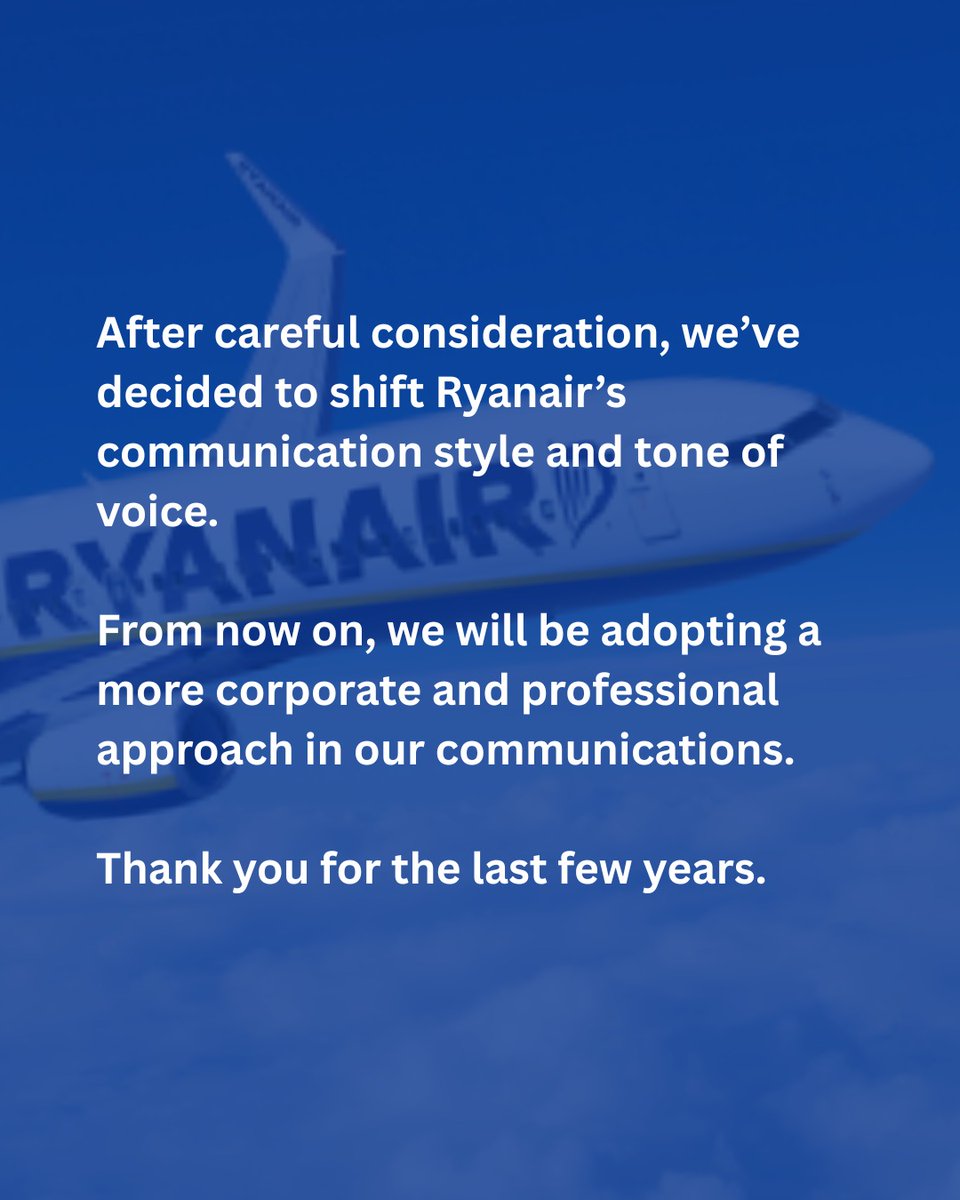
Ryanair’s play was simpler but arguably the sharpest: the airline announced it would be pivoting to a “more corporate and professional” communication style, effective immediately. And here is the brilliant detail: Ryanair actually dropped their announcement on the evening of March 31st. By posting it right before April 1st, they caught audiences and aviation forums off-guard before everyone’s “April Fools radar” was fully activated for the next day.
For a brand whose social voice is built on chaos and chaos alone, the reversal was credible enough to fool thousands, generating millions of impressions across Twitter, Instagram, and aviation forums within hours.
The lesson here is that April Fools works best when it’s rooted in your actual brand identity. Ryanair didn’t borrow someone else’s joke format. They turned their own personality inside out. Brands that try to be funny in a voice they don’t own on any other day of the year tend to read as exactly that.
The Influencer Angle: Ryanair understands that creators thrive on cultural commentary. By flipping their famously chaotic brand voice, they provided the perfect setup for commentary creators, aviation influencers, and marketing analysts to stitch, duet, and dissect the move in real-time.

4. Dunkin’: Prank Energy, Real Value
Dunkin’ skipped the fake product entirely and gave away 1,000,001 free hot or iced coffees to rewards members who entered promo code “STILLNOTAJOKE” on April 1. The number itself is the joke, and the fact that it wasn’t a joke is the whole point.
This is smart activation design for brand marketers to study. Giving away 1,000,001 coffees was brilliant from a data-capture standpoint. The offer required Dunkin’ Rewards membership to redeem, nudging non-members to sign up in the process. It was a user-acquisition play disguised as an inside joke.
When the real offer is the prank, you eliminate the post-reveal deflation that kills most April Fools campaigns. Creators and customers shared it because it was worth sharing, not because they were asked to. Creator marketing spend is projected to reach $44B in the U.S. in 2026, an 18% jump from last year. In that environment, organic amplification driven by genuine value isn’t a nice-to-have. It’s a competitive advantage.
The Influencer Angle: Dunkin’ proved that real value is the ultimate driver of user-generated content (UGC). Deal-hunting creators and lifestyle influencers rushed to share the “STILLNOTAJOKE” promo code because passing savings onto their followers boosts their own credibility and engagement rates.
5. DUDE Wipes: Committed to the Bit
DUDE Wipes introduced the Butt Mask, a hydrogel disc positioned as “the skincare treatment for the one area skincare forgot,” promising whitening, tightening, and cooling in 15 minutes. It’s on-brand, it’s gross in exactly the right way, and it generated the kind of reaction content that makes any brand social manager’s week.
What DUDE Wipes consistently gets right is that their audience wants to share their content. That kind of built-in creator behavior is the result of brand consistency over time, not one lucky April Fools post. 93% of brands report that UGC outperforms traditional branded content. DUDE Wipes didn’t need to orchestrate it. They built an audience that does it for them.
The Influencer Angle: The Butt Mask worked because DUDE Wipes already operates with a creator-first mindset year-round. They have cultivated a community of brand advocates who inherently know that sharing the brand’s unhinged content acts as a form of social currency.
The Bottom Line: What April Fools 2026 Taught Us About Influencer Marketing
The best April Fools influencer marketing activations in 2026 proved that the definition of influencer marketing is expanding. You don’t always need a traditional sponsorship to activate the creator economy. Brands that build concepts with inherent shareability, stay true to their voice, and give audiences something tangible to react to can generate organic amplification that money can’t buy. Every activation above started with a strong creator brief at its core, even if no creator was ever officially briefed. The formula isn’t complicated: build the hook, and the creators will come.
Citations
[1] The World’s About to Get the First Meatball-Tasting Lollipop (Ingka Group / IKEA)
[2] The Best April Fool’s Day Pranks from Meatball Lollipops in IKEA, Wickes’ Moon-Powered Panels and a Dyson Airwrap Fit for a Cat (PapaLinc)
[3] April Fools’ Day 2026: Top Jokes from Dude Wipes, Tesco, Babybel and More (The Drum)
[4] Brands Get Cheeky For April Fool’s Day (MediaPost)
[5] April Fools! The Most Ridiculous Stunts of 2026 and Freebies That Are No Joke (AOL)
[6] Creator Economy Live 2026: What Brands Need to Know About UGC, Creators & the Future of Marketing (BrandLens)
[7] User Generated Content: Complete Guide for Brands in 2026 (DigitalVerto)